
Uncategorized
NanRobot D6+ 2.0 Review: Is This Off-Road Electric Scooter Worth Your Money?

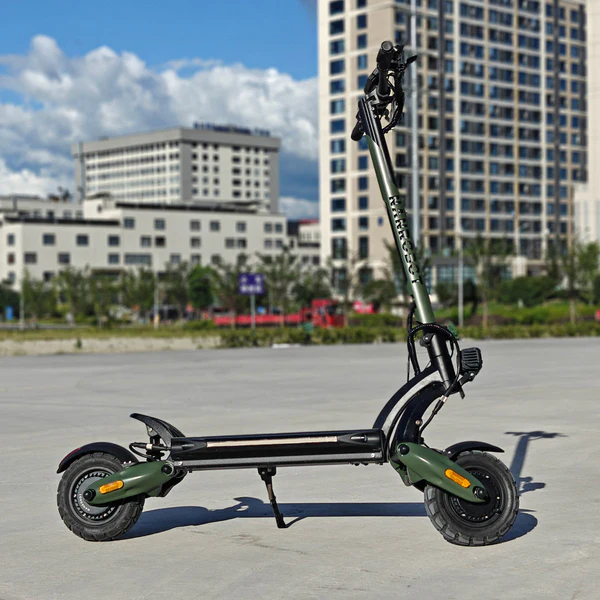
Off-road electric scooters tend to fall into one of two camps: overpriced boutique builds or budget models that can’t survive a pothole. The NanRobot D6+ 2.0 has spent the past few years trying to carve out a middle ground — dual motors, full suspension, and a genuinely usable range, without pricing itself alongside the true flagship machines. From my research into the manufacturer’s specifications and a range of independent rider reviews, it’s clear this scooter has built a loyal following among riders who want speed and durability without spending upward of two thousand dollars.
What stood out to me while digging into this model is how consistently reviewers describe the same trade-off: strong, confidence-inspiring performance paired with a handful of rough edges that feel more like cost-saving decisions than genuine engineering flaws. That combination is worth unpacking in detail before you decide whether it belongs in your garage.
Who It’s For
The D6+ 2.0 is aimed squarely at riders who want one scooter that can handle both a paved commute and a weekend trail ride. Based on the available information, it seems best suited to adults who prioritize power and durability over portability — this is not a scooter you casually sling over your shoulder onto a train platform.
Best Users
- Commuters with longer routes who want a real range buffer rather than cutting it close
- Riders who split their time between city streets and unpaved paths or light trails
- Heavier riders, since the 330 lb (150 kg) load capacity is above average for the category
- Anyone who values do-it-yourself repairability and wants a scooter with widely available parts
Who Should Skip It
- Anyone who needs a lightweight, easily foldable scooter for stairs or public transit — at roughly 77 lbs, this is a heavy machine
- New riders who aren’t comfortable with a scooter capable of 40 mph
- Buyers who want a minimalist commuter design rather than an aggressive, off-road-styled build
Design & Build Quality
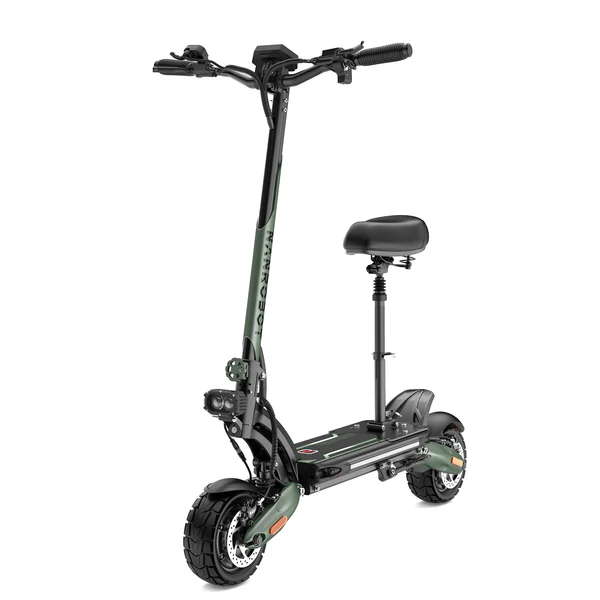
Looking at the overall design, the D6+ 2.0 leans into a rugged, utilitarian aesthetic rather than the sleeker lines you’ll find on commuter-focused scooters. The frame is aluminum alloy, which keeps the weight from being even higher while still giving the deck enough rigidity to handle two motors’ worth of torque. The wide, 10-inch pneumatic off-road tires are one of the more frequently praised elements across owner feedback — they smooth out rough pavement and give the scooter genuine trail capability that street-only tires simply can’t match.
Suspension is a real highlight here. The front and rear hydraulic C-type spring shocks do a noticeably better job absorbing impacts than the spring-only setups found on cheaper competitors, and several reviewers specifically called out how composed the ride feels even at higher speeds. The deck is wide and padded with a grippy, rubberized surface, and the telescoping folding stem uses a two-stage locking mechanism, which adds a layer of reassurance given how much speed this scooter is capable of.
Where the build quality gets more mixed is in the smaller details. Multiple reviews mention that the folded position doesn’t lock, so the scooter can unfold itself if jostled during transport — a minor annoyance rather than a dealbreaker, but worth knowing before you buy. The control buttons on the handlebar have also been described as feeling a bit dated compared to rivals with more refined displays.

Performance & Features
Under the deck, the D6+ 2.0 runs dual 1000W hub motors for a combined 2000W of power, drawing from a 52V 26Ah lithium-ion battery — a pack large enough to put it ahead of several similarly priced rivals on paper. NanRobot lists a top speed of around 40 mph and a range in the 30 to 40 mile window, though as with any electric scooter, real-world range depends heavily on rider weight, terrain, and how often you’re running in the more power-hungry dual-motor mode.
One thing worth mentioning is that the scooter offers switchable riding modes — an eco, single-motor setting for stretching battery life, and a turbo, dual-motor setting for hill climbs and quicker acceleration. That flexibility is a genuinely useful feature rather than a marketing checkbox, since it lets you tailor the ride to whether you’re commuting efficiently or tackling an incline.
Braking comes from a combination of hydraulic or disc brakes (depending on configuration) plus an electronic braking system, which several independent reviewers noted provides confident, predictable stopping power — an important consideration on a scooter capable of highway-adjacent speeds. Lighting includes a headlight, taillight, turn signals, and side lighting strips, all of which matter more than they might seem given how often this scooter’s power invites dusk or night riding.
Charging is one area with a genuine trade-off: a single charger takes roughly 10 to 12 hours to fill the battery, though NanRobot sells a dual-charger setup that cuts this down to around five hours. It’s also worth noting that NanRobot’s documentation recommends plugging the charger into the scooter before the wall outlet, which is the reverse of most other scooters and can trip up new owners.

What I Liked
- Strong dual-motor power that consistently outperforms similarly priced single-motor scooters on hills
- Large 1352Wh battery capacity that gives a real range cushion compared to close competitors
- Full hydraulic suspension that noticeably improves comfort on rough or unpaved surfaces
- Wide, grippy deck and solid 330 lb load capacity, making it a good fit for larger riders
- Modular, plug-and-play electrical components that make DIY repairs more approachable
What Could Be Better
- At around 77 lbs, it’s not a scooter you’ll want to carry any real distance
- No locking mechanism for the folded position, which can be inconvenient during transport
- Side lighting has been described as underpowered compared to the front and rear lights
- Single-charger charging time (10+ hours) is slow unless you invest in the dual-charger option
- Handlebar controls and display feel a generation behind some newer competitors
Comparison
The D6+ 2.0 competes in a crowded segment of dual-motor, off-road-capable scooters, and it’s most commonly compared to the Varla Eagle One and the Zero 10X (also sold under names like the Turbowheel Lightning). Here’s how the core specs stack up, based on manufacturer listings and third-party reviews.
| Model | Motor Power | Battery | Top Speed | Weight |
|---|---|---|---|---|
| NanRobot D6+ 2.0 | 2000W (dual 1000W) | 52V 26Ah (1352Wh) | ~40 mph | ~77 lbs |
| Varla Eagle One | 1600–2000W (dual) | 52V ~18.2Ah | ~40 mph | ~77 lbs |
| Zero 10X | 1600–2000W (dual) | 52V ~18Ah (936Wh) | ~40 mph | ~78 lbs |
What separates the D6+ 2.0 from both rivals, based on the specs above, is battery capacity — its 1352Wh pack is meaningfully larger than what you’ll find on the Eagle One or Zero 10X, which helps explain why range tends to come up as a strong point in owner feedback. The Varla Eagle One is often cited as having a slightly more polished app and display experience, while the Zero 10X has a broader base of aftermarket parts and community support built up over a longer time on the market. If battery capacity and suspension comfort are your priority, the D6+ 2.0 has an edge; if refinement and ecosystem maturity matter more to you, the competitors are worth cross-shopping.

Final Verdict
Based on the available information, the NanRobot D6+ 2.0 earns its reputation as a capable, no-nonsense off-road electric scooter. It doesn’t try to be the lightest, the most refined, or the most technologically advanced option in its class — instead, it focuses on power, range, and ride comfort, and largely delivers on all three. The trade-offs are real but predictable: this is a heavy, utilitarian machine with a few dated touches, not a scooter built for portability or polish.
For riders who want strong hill-climbing performance, a battery that won’t leave them stranded, and suspension that can handle imperfect pavement or light trails, it’s a reasonable investment. If you’re shopping for your next off-road-capable scooter, it’s worth comparing current pricing and configurations directly. You can check the current price on the official store to see the latest battery options and availability.
Editorial Rating: ★★★★☆ 4.4/5
This rating reflects a scooter that performs strongly where it counts — power, range, and suspension — while losing a bit of ground on portability, charging speed, and a few finishing touches that feel slightly behind more recently refreshed competitors.
FAQ
Is the NanRobot D6+ 2.0 good for daily commuting?
It can handle a commute well, especially a longer one, thanks to its range and power. The main downside for commuters is its weight — if you need to carry it up stairs or onto public transit regularly, it may feel cumbersome.
How long does the battery actually last?
NanRobot advertises a range of up to 40 miles, though real-world figures tend to land closer to 30 to 35 miles depending on rider weight, terrain, and how much time you spend in the higher-power dual-motor mode.
Does it require much maintenance?
Like most powerful dual-motor scooters, it benefits from regular tire pressure checks, brake inspections, and suspension upkeep. The modular, plug-and-play wiring design is intended to make basic repairs more approachable for owners who prefer not to rely on a repair shop.
Is it suitable for beginners?
Given its 40 mph top speed and substantial weight, it’s better suited to riders with at least some prior scooter experience. Beginners can still use it safely by sticking to lower power modes while they build confidence, along with wearing proper safety gear.
What’s the difference between the 52V and 60V versions?
The 60V configuration uses a different battery chemistry that’s generally reported to be more durable, along with a modest speed increase over the standard 52V version. It typically comes at a higher price point.
Check price on official store →

-

 AI Tools Review1 year ago
Pictory Review (April 2025): The Best AI Video Generator?
-

 AI Tools Review1 year ago
Colossyan Creator Review: The Best AI Video Generator?
-

 AI Tools Review1 year ago
WellSaid Labs AI Voice Generator Review (April 2025)
-

 AI Tools Review1 year ago
Facetune Review: The Ultimate AI Photo App to Edit Selfies
-

 AI Tools Review1 year ago
Flick Review: The Best Instagram Hashtag Tool to Boost Reach
-

 AI Tools Review1 year ago
ElevenLabs Review: The Most Realistic AI Voice Generator?
-

 AI Tools Review1 year ago
HeyGen Review: The Best AI Video Generator for Businesses?
-

 AI Tools Review1 year ago
Scalenut Review: The Best AI SEO Writing Generator? (April 2025)